One package boasts about protein; another promises more fiber. When both words appear during the same shopping trip, it feels like you have to choose which nutrient deserves the spotlight. However, the useful question isn't which one wins, but rather what is missing from your usual meals and what you can incorporate without displacing other important foods.
Protein and fiber fulfill different functions. Neither one alone turns a product into a good choice, nor does a highlighted number describe everything you eat. Looking at your plate, the label, and your context is usually more helpful than chasing the trending ingredient. This guide suggests doing so with everyday examples, rather than with a mandatory quantity for everyone.
Two nutrients, two different tasks
Protein provides amino acids that the body uses to build and maintain tissues. It isn't just for the gym: it's part of the body's daily functioning. Eggs, fish, dairy, legumes, and soy foods can all contribute to your intake. MedlinePlus notes that needs depend on factors such as age, health, and physical activity, among others.
Fiber includes dietary components that are not digested like available carbohydrates in the small intestine. Its role in bowel function explains part of its appeal, although not all fibers have the exact same properties. Legumes, whole grains, fruits, and vegetables offer different ways to incorporate it, as EFSA documentation outlines.
These functions are not interchangeable. A protein-rich food does not automatically provide fiber, and a food containing fiber does not guarantee that a meal meets your protein needs. There are also foods that combine both, especially legumes. Classifying each ingredient into a single box can obscure precisely what is most interesting about their composition.
See what repeats and what barely appears
Before buying an enriched product, look at several real meals, including those you eat away from home. Is there any recognizable protein source? Do legumes, vegetables, fruit, or whole grains appear? This review does not diagnose a deficiency; it serves to identify repeated choices and decide what deserves a closer look.
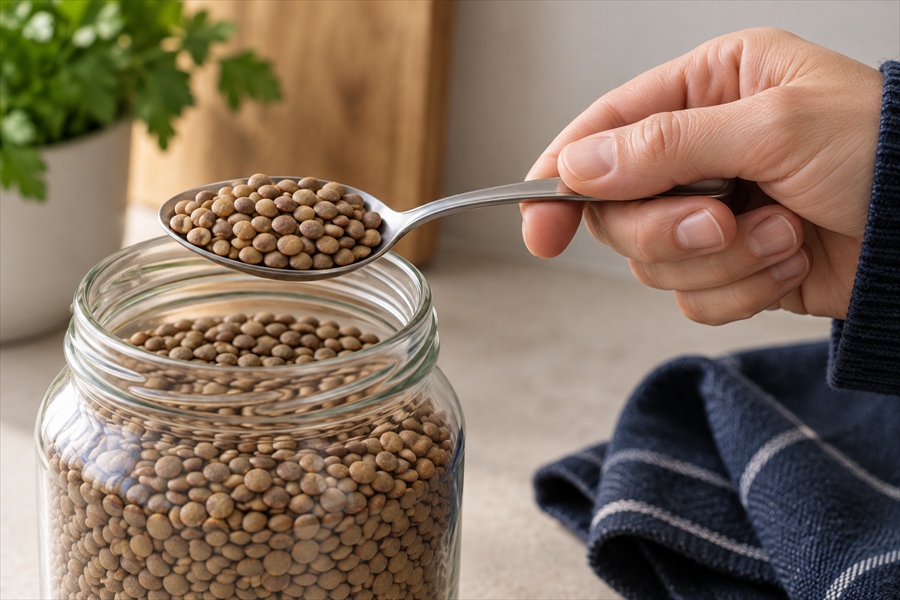
Think of a plain yogurt breakfast. It can be a protein base, but its accompaniment changes the whole: fruit and oats add foods with fiber. In a meal of lentils with vegetables, on the other hand, there are already contributions of both nutrients. Automatically adding another protein product is not a conclusion that can be drawn solely from the name of the dish.
The goal is not for all meals to be identical either. A simple dinner, a shared meal, and a quick breakfast have different contexts. Review the pattern without punishing exceptions. The variety recommended by the WHO allows combining food groups; it does not force you to repeat a perfect menu or eliminate dishes you enjoy.
What a trial can tell, and what it cannot
A trial by Te Morenga and colleagues, published in 2011, randomly assigned 83 overweight or obese women to two weight-loss diets; 74 completed eight weeks. Both reduced energy and received nutritional support. One prioritized protein and the other fiber-rich foods. It did not compare isolated nutrients nor a diet with protein versus one without it.
The mean weight change was −4.5 kg and −3.3 kg, respectively. The adjusted difference between groups was −1.3 kg in favor of the higher-protein diet, with a 95% confidence interval of −2.5 to −0.1 kg. It is an adjusted statistical estimate, not the simple subtraction of the rounded means.
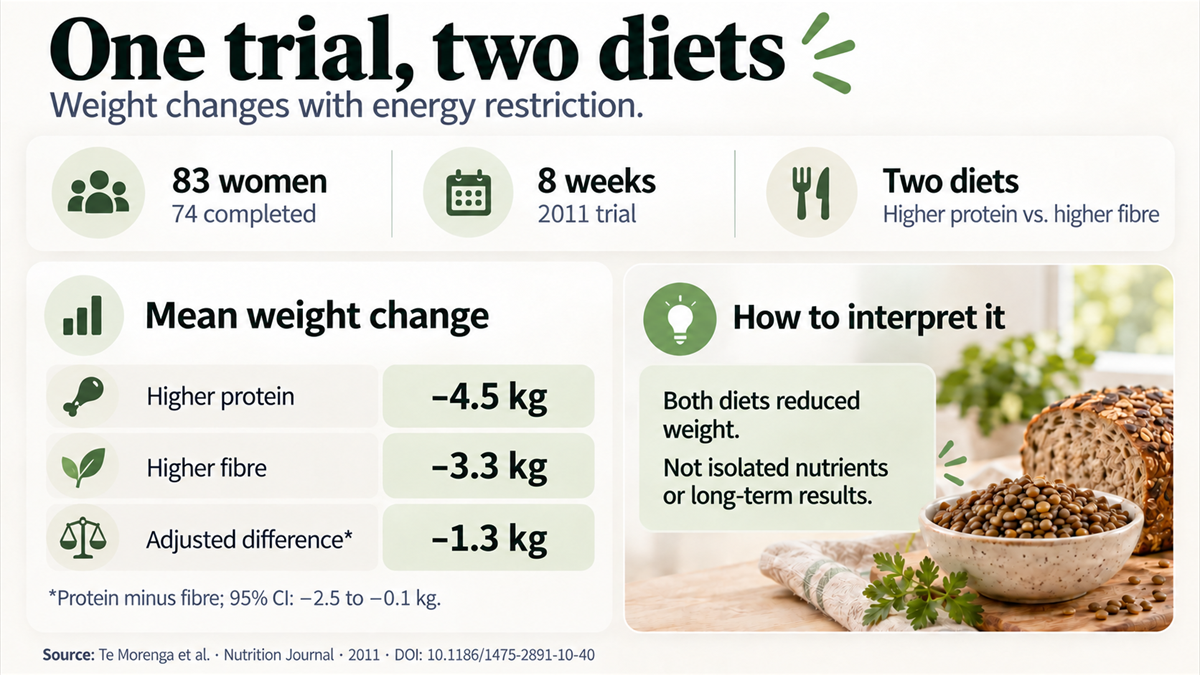
The follow-up was short and the results do not indicate what would happen to just anyone or in the long term. Furthermore, the analysis was done with those who completed the study. Its usefulness here is to learn to read context and limitations. The article does not propose losing weight as a general objective nor transferring that protocol to your diet.
Read the whole label, not just the claim
To compare similar products, start by checking that you are using the same baseline: values per hundred grams are not the same as those for a single serving. Then, look at how much you would actually consume. A number might seem higher because it corresponds to a larger portion, not because the food is more concentrated in that nutrient.
Read protein and fiber together when both are listed, but keep looking at ingredients, energy, sugars, and salt. A product highlighting one nutrient does not explain its complete composition. Nor does the absence of data in an app allow you to conclude that the food doesn't contain it: information might just be missing in that entry.
For example, two breads can differ in ingredients and composition even if they share an attractive description. An enriched dessert and a plain yogurt are not interchangeable just because of their protein content. Compare products that serve a similar purpose and then decide how they fit into your meal, your budget, and your preferences.
Make combinations you can repeat
Putting this into practice can start at the grocery store, without supplements or complicated recipes. Choosing cooked legumes, frozen vegetables, or whole wheat bread makes different combinations easier when you are short on time. They are not exact equivalents of one another: they are resources so that variety doesn't depend on cooking from scratch every day.

A chickpea and tomato salad can serve a different purpose than an omelet served with vegetables and whole wheat bread. Oatmeal with yogurt and fruit offers another possible combination. These are culinary examples, not prescribed menus or promises to cover individual needs: portions and the rest of your day still matter.
Start with a change that fits into your routine and see how you tolerate it. The NIDDK advises increasing fiber gradually and pairing it with adequate hydration. This doesn't mean forcing yourself to eat large quantities or drink a fixed amount of water: your needs also depend on your personal situation.
A simple way to organize this is to start with a meal you already like and ask what you could incorporate or alternate. There is no need to change breakfast, lunch, and dinner all at once. If a proposal requires ingredients you can't find, a lot of time, or an expense that doesn't fit, look for another combination. The value of these examples lies in opening up options, not in creating a to-do list. Reviewing afterward what you've been able to maintain provides more practical information than designing an ideal menu that only works on paper.
An app helps if you review your log
If you use a nutrition app, first check what information it allows you to enter and correct. When it supports photos, these can serve as a reminder, but a single image does not document all ingredients and quantities by itself. Review the description and portion size; do not treat an automatic estimate as a laboratory measurement.
Also look at the log's coverage. A week with logged breakfasts and missing dinners does not represent the full week. When reviewing fiber and protein, it makes more sense to correct obvious omissions than to interpret decimals with false precision. If nutritional data is missing, cross-reference it with the packaging or a documented entry, rather than filling it in by intuition.
Conclusion: prioritize what is missing, not the trend
Fiber and protein do not need a winner. The practical decision consists of recognizing their functions, looking at the meals you repeat, and choosing sustainable changes. Sometimes you will pay more attention to legumes and whole grains; other times, to a protein source that barely appears. The answer comes from the whole picture, not from the biggest claim on the package.
Sources and references
- MedlinePlus. 2024. Dietary Proteins. Function, sources, and variability of protein needs. Accessed September 16, 2026.
- EFSA. 2017. Dietary Reference Values for nutrients: Summary report. Fiber framework and definition; not used as an individual prescription. DOI: 10.2903/sp.efsa.2017.e15121.
- WHO. 2026. Healthy diet. Diversity and food groups. Accessed September 16, 2026.
- Te Morenga et al. 2011. Comparison of high protein and high fiber weight-loss diets in women with risk factors for the metabolic syndrome: a randomized trial. Nutrition Journal, 10:40. DOI: 10.1186/1475-2891-10-40. Full text used for the article and infographic.
- NIDDK. 2018. Eating, Diet, & Nutrition for Constipation. Gradual introduction of fiber, hydration, and professional adaptation. Accessed September 16, 2026.
- Dalakleidi et al. 2022. Applying Image-Based Food-Recognition Systems on Dietary Assessment: A Systematic Review. Advances in Nutrition, 13(6):2590–2619. DOI: 10.1093/advances/nmac078. Review of image-based food recognition and nutritional estimation steps.