The photo is only the beginning. A single meal can provide an estimate, but it doesn't explain how you eat over the course of a week. The real value of keeping a log emerges when you can review everything together: which foods repeat, which meals are missing, and in what situations it is hardest to stick to the choices you had planned.
The statistics from an AI-powered nutrition app should help you ask better questions, not just monitor a number. A history can become a practical memory to help decide what to buy, what to prepare, and what to discuss with a professional. To achieve this, you need to distinguish between what you logged, what the system estimated, and the interpretation it builds afterwards.
One meal is an observation; a history provides context
Photographing a plate reduces the effort of remembering its ingredients. However, the image doesn't reveal with certainty the oil used, the weight of each food, or what was left uneaten. Before saving the result, it's a good idea to review the identification, correct portions, and add what's missing. That verification remains important even if the app seems to recognize everything at first glance.
When you repeat this process, different questions arise: do you usually include vegetables at dinner? Which breakfasts are practical for you? Does your organization change when you eat out? These are examples of reading your history, not automated diagnoses. The usefulness lies in connecting meals with situations you recognize, without turning a one-off choice into a label about your diet.
Saving more photos also doesn't eliminate a recurring error. If the system consistently misses sauces, the average will continue to carry that omission. Research on image-based food recognition explains why identifying foods and estimating quantities are two different problems. A longer history provides context, but it does not guarantee nutritional accuracy on its own.
First, check which part of the week is recorded
The first statistic that deserves attention is coverage: how many days and meals are represented. An empty space can mean that you forgot to take a picture, that you logged later, or that you didn't eat. The app shouldn't choose an explanation without asking you. Nor should it fill that gap with zero calories and present the result as if it described a complete day.
Before comparing weeks, check whether both include similar situations. A week with full homemade meals does not cleanly compare to another where you only photographed breakfasts. Pointing out incomplete days, travel, and schedule changes allows you to better interpret what you see. The quantity of logs must accompany any conclusion that appears to describe a trend.
Which statistics can help you decide
Averages summarize, but they can hide differences. Along with the daily mean, it is useful to review the distribution across days and the original meals that explain it. The median can provide another perspective when there are particularly different days. None of these measures automatically turns a visual estimate into exact data: they still depend on the quality of the log.
You can also look at frequencies and variety: the presence of legumes, vegetables, fruits, or different protein sources. For that reading to be understandable, the app should explain how it classifies foods and allow you to correct them. A pizza with vegetables, for example, does not necessarily equal an identifiable serving of vegetables. Counting labels without context can produce a misleading impression.
Schedules, meals away from home, and your own notes can complete the picture. If you choose to log hunger, comfort, or circumstances, that data helps explain a week; it does not prove cause-and-effect relationships. Two things coinciding several times is not enough to claim that one causes the other. The system should present these coincidences as reviewable questions.
A good screen allows you to move from the summary to the specific logs. This way you can check whether the pattern exists, whether it stems from an error, or whether it reflects an exceptional situation. It should also show the period used and the definition of each indicator. The best dashboard is not necessarily the one with the most charts, but the one that makes it easy to understand where each observation comes from.
What a study allows us to state about tracking
The SMARTER trial, published by Burke and colleagues, compared self-monitoring with and without personalized messages in 502 adults over 12 months. Both groups received initial guidance and tracking tools. The mean weight change was −2.12% with messages and −2.39% without them; the difference between groups was not statistically significant, with p = 0.68.
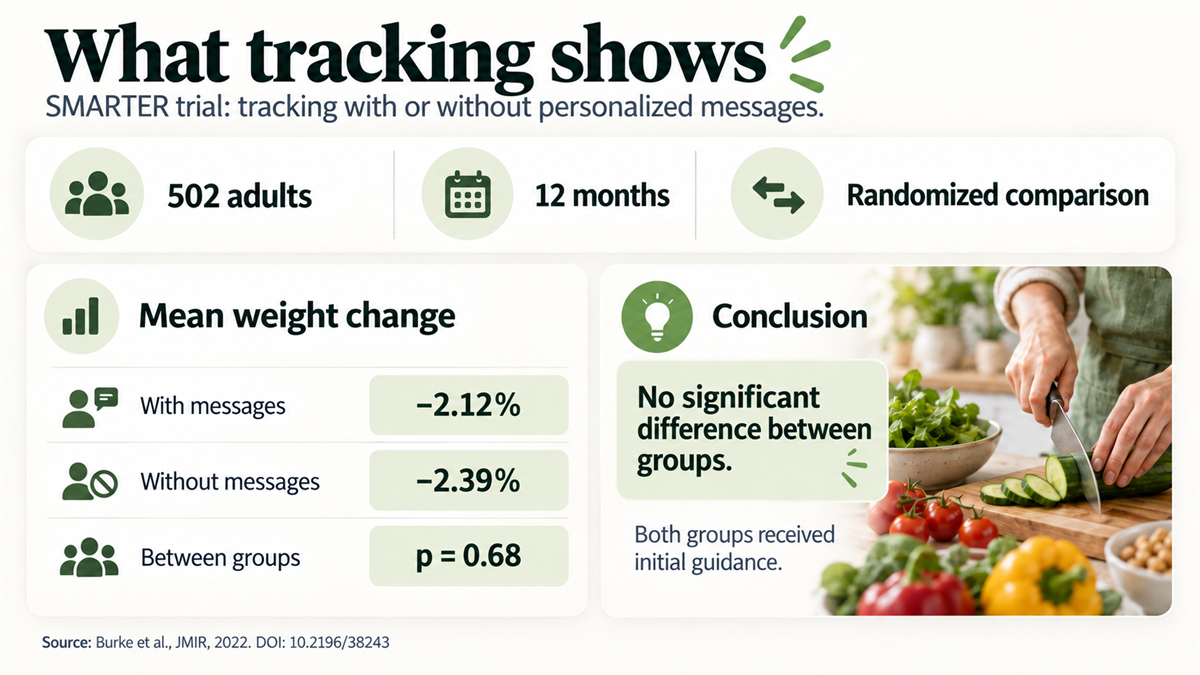
The result places a limit on promises: more messages did not produce greater weight loss in that trial. It does not prove that reviewing habits lacks value, nor does it prove the efficacy of current AI food photography apps. It studied a specific intervention and a specific outcome. Understanding patterns, improving organization, and changing weight are related but distinct goals.
The small MyBehavior study explored recommendations based on logs and routines. Its participants valued the personalization, although the dietary difference between groups was not significant. The idea of adapting advice to context is interesting; its efficacy must be tested and not deduced from a convincing interface.
From an observation to a change you can test
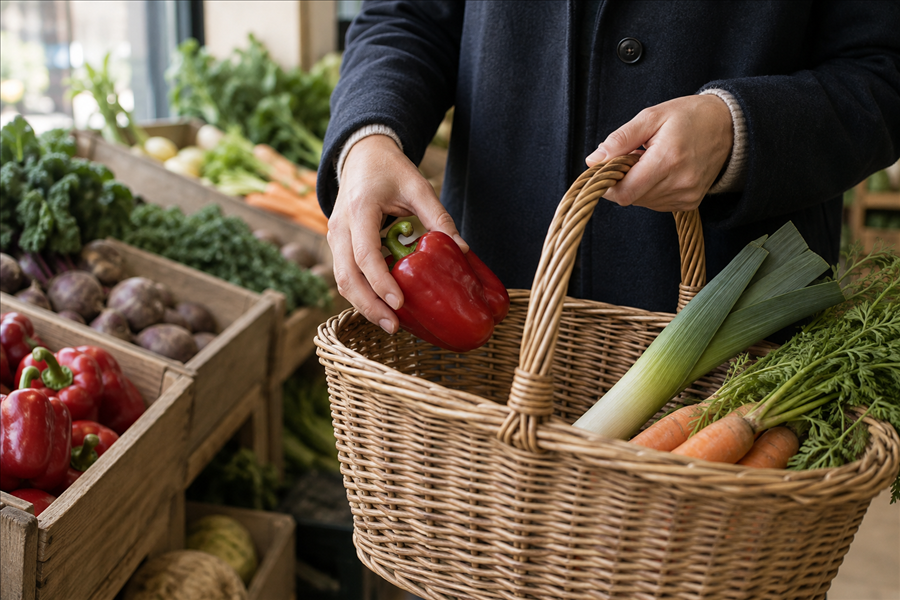
Imagine that, when reviewing your photos, you find few vegetables in the dinners you improvise when arriving home late. This is a hypothetical example, not a study result. The practical response could be to leave a prepared option, buy frozen vegetables, or agree on a simple dinner that fits your schedule. The proposal stems from a recognizable circumstance and you can evaluate whether it actually makes eating easier.
Next, it is best to choose a single question for the following review: was the preparation useful to you?, did you like it?, were you able to maintain it? You do not need to compensate for previous meals or chase a perfect score. If the idea does not fit, modifying it provides information. The purpose of tracking is to facilitate decisions, not to create an additional obligation that competes with your daily life.
What to demand from an app before trusting its summary
Look for traceability: access to the original photograph, the ability to correct ingredients, and an explanation of the analyzed period. Ask it to differentiate between data you entered and estimates, and to point out incomplete logs. A clear explanation should be verifiable against your history. Absolute statements about metabolism, intolerances, or diseases require evidence that a collection of photographs cannot provide.
Also check the options to export and delete information, and verify how the images are used. A food history can reveal personal routines. If you want to share it with a professional, a comprehensive summary accompanied by original logs can facilitate the conversation. The decision to share must be under your control, with clear information about the recipients and the purpose.
The experience should help you observe without guilt. If logging every meal increases anxiety or pushes you to restrict rigidly, it is worth reconsidering its use and speaking with a professional. Clinical needs, the treatment of diseases, and individual nutritional goals require an evaluation that goes beyond an app's dashboard.
Understanding how you eat is more than accumulating numbers
The value of an app appears when you can recognize your own life in the history and use it to make a reasonable decision. Photographing, reviewing, and contextualizing are parts of the same process. Good statistics show their limits, explain what data they use, and allow you to correct them. Thus, weeks of logs can become a help in understanding your habits, with room for flexibility and without promises that evidence does not yet support.
Sources and references
- Burke LE et al. (2022). The Effect of Tailored, Daily, Smartphone Feedback to Lifestyle Self-Monitoring on Weight Loss at 12 Months: the SMARTER Randomized Clinical Trial. Journal of Medical Internet Research, 24(7):e38243. DOI: 10.2196/38243.
- Rabbi M et al. (2015). Automated Personalized Feedback for Physical Activity and Dietary Behavior Change With Mobile Phones: A Randomized Controlled Trial on Adults. JMIR mHealth and uHealth, 3(2):e42. DOI: 10.2196/mhealth.4160.
- Dalakleidi KV et al. (2022). Applying Image-Based Food-Recognition Systems on Dietary Assessment: A Systematic Review. Advances in Nutrition, 13(6):2590–2619. DOI: 10.1093/advances/nmac078.