Glucose sensors show rises and falls in people without diabetes too: a flat line is not the usual pattern. In Shah and colleagues' study, the median time between 70 and 140 mg/dL (3.9–7.8 mmol/L) was 96%, with brief periods outside that range.
If you have started checking your graph after breakfast, three distinctions matter: what the device measures, what researchers observed in healthy participants, and what to do with that information. A meal, a night's sleep or a walk provides details that the highest point on your screen cannot capture. Looking at those circumstances lets you reconstruct what happened before deciding whether any adjustment is needed.
What does a sensor measure, and how accurate is it?
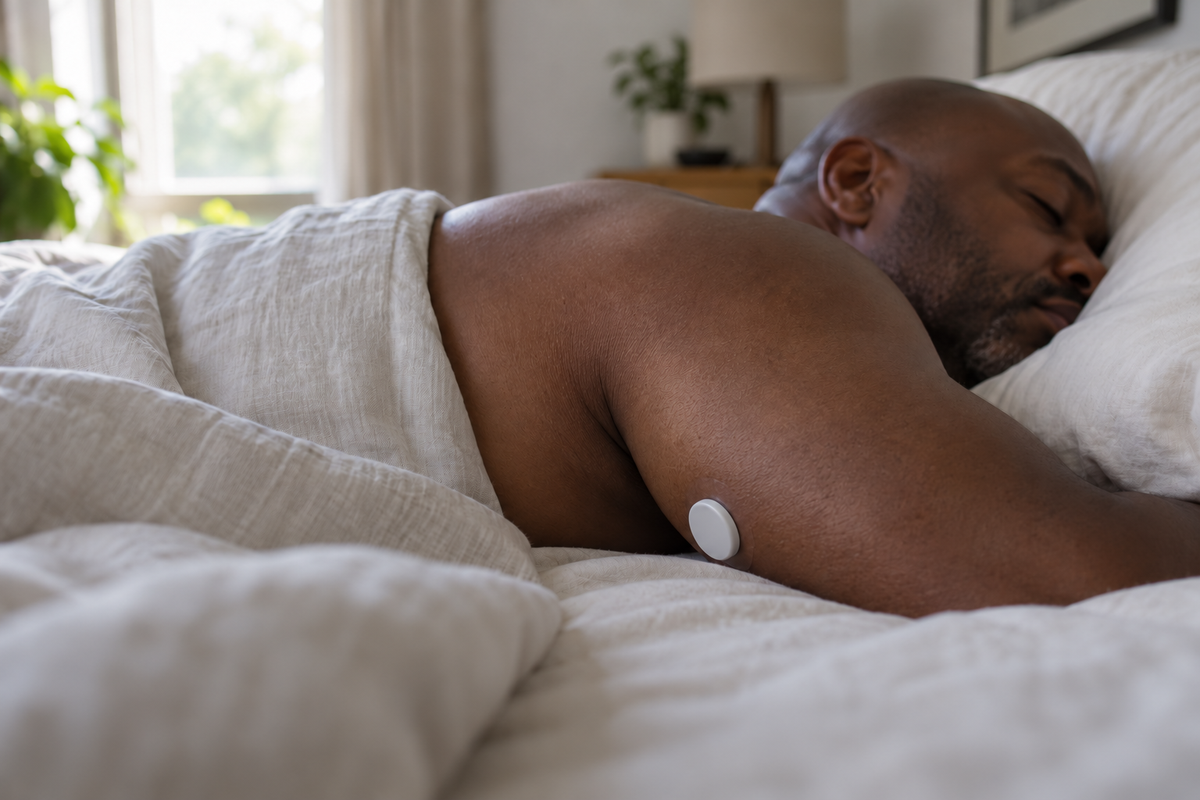
A small filament beneath the skin measures glucose in the fluid surrounding your cells. The NIDDK explains how a device sends results to a phone or receiver to follow trends throughout the day. A finger-prick test, meanwhile, analyses a drop of blood; the two methods sample different places.
Accuracy depends on the model and the conditions of use. In Shah's research, the Dexcom G6 had a mean absolute relative difference of 6.0% compared with finger-prick measurements. That average summarises discrepancies across the dataset, rather than assigning the same error to every reading or to other products sold today.
Adhesive, signal and operating problems also occur. The researchers suggested pressure on a sensor during sleep as a possible reason for some recorded lows. A dip at night while resting on that arm therefore raises a possible technical cause that needs distinguishing from a response to dinner.
What variations occurred in healthy participants?
Shah's team followed 153 participants without diabetes, aged 7–80, for an average of eight days. The results were hidden from participants, and researchers observed everyday life without assigning diets or comparing treatments.
Glucose also varies without diabetes
Median time between 70 and 140 mg/dL (3.9–7.8 mmol/L)
Median time in each interval
Medians calculated separately; they do not sum to an individual profile.
Participants spent most of their time within the studied range, with brief excursions on either side. That puts an occasional rise into context without treating every food as a problem. The main limitation is the selected sample, which excluded obesity and conditions affecting glucose metabolism.
The range observed in that research is not a personal diagnostic test. The American Diabetes Association considers the evidence insufficient for sensors for screening for or diagnose prediabetes and diabetes. Diagnosis requires blood tests and a clinical assessment, chosen by your healthcare professional according to symptoms and medical history.
How should I interpret a rise after eating?
Start by identifying the preparation and how much you ate. “An orange and yoghurt” leaves the fruit's size, yoghurt portion, additions and timing unspecified. A short note containing those details captures breakfast more clearly than a screenshot of its highest reading.
A plate of rice, vegetables and egg does not isolate one ingredient either. If you alter the amount of rice, the time and your walk afterwards together, you are comparing different circumstances. Keeping a familiar meal and noting any differences makes the question easier for someone else to understand.
Separate events from the cause you propose. “I ate, walked and the value rose” recounts a sequence; attributing that rise to walking needs an organised comparison. Repeating an observation on different occasions may help you describe a pattern, although other differences between those days remain.
The WHO includes fruit, pulses and whole grains in a varied diet. For other characteristics of your plate, what fibre and protein contribute offers a way to look beyond the graph. A glucose response does not capture every nutritional feature of the foods you have eaten.
Can it help me change my habits?
Makkena and colleagues' review found signs of dietary changes when adults without diabetes saw their results. Studies differed and often added education or professional support. Evidence for behavioural change was of low certainty.

A complete programme and a sensor are different interventions. If participants received conversations, goals and follow-up, purchasing the device does not reproduce those conditions. Nor does a lower reading after one meal demonstrate that your long-term health will improve.
Before starting, define a limited task: describing a breakfast that concerns you, or preparing a question about whether you need blood tests. That objective makes it easier to recognise when you have enough information. An answer from a consultation provides a different stopping point from repeatedly trying to keep the display steady.
A notebook is enough for foods, amounts and times. If you choose photographs as an aid, the limits of calorie calculations from a photo explain which details remain hidden. Added oil and anything left on the plate still need your input.
When should I pause and ask for help?
Notice whether tracking affects your relationship with food and other people. The NHS describes warning signs such as avoiding social occasions involving food or following very rigid eating routines. Even with an apparently orderly graph, worry sometimes interrupts everyday activities.
- You avoid eating with other people to control every ingredient.
- You repeatedly check the display and struggle to return to what you were doing.
- You start fearing familiar foods or cutting meals because of their glucose curve.
Makkena's review discusses concerns about anxiety and restriction, without establishing that these devices cause eating disorders. Describing those behaviours helps a professional understand what is happening; it does not diagnose a condition. If they appear, pause voluntary tracking and seek professional help; someone you trust can accompany you.
Where can I buy one, and what are the ongoing costs?
Replacement sensors turn an initial price into recurring spending. As a US example, the Stelo shop offers two sensors for US$99 as a one-off purchase, two for US$89 with monthly shipments, or six for US$252 every quarter. Each lasts up to 15 days; these are US offers rather than UK prices.
In 2024, the FDA cleared Stelo for certain adults aged 18 or over who do not use insulin, including people without diabetes. That US clearance does not automatically apply elsewhere. The intended purpose and user population depend on the product you plan to obtain.
In the UK, adults without diabetes can buy Lingo through its UK website, where it is sold for non-medical use from age 18. The advertised two-week plan costs £59 for one sensor and does not renew automatically. An estimated 28-day replacement budget is £118: £59 × 2, with each sensor lasting up to 14 days.
Ongoing use therefore requires further sensors; a one-off trial does not pay for subsequent months. The UK support service explains that subscription plans supply two sensors every 28 days. The £59 offer is the single-purchase plan, so it should not be presented as a subscription price.
The NHS describes funded monitoring for people with diabetes, with clinical eligibility conditions. That pathway does not include buying a wellbeing sensor out of curiosity without diabetes. Its patient guidance concerns NHS services in England; arrangements in Scotland, Wales and Northern Ireland have their own pathways.
Before paying, check your phone's compatibility and replacement terms if the adhesive irritates your skin or a sensor comes off. Skin irritation and occasional failures are among the problems listed by the NIDDK. Automatic renewals create different commitments from a single purchase, including when payment and cancellation take effect.
How can I organise notes without changing everything?
When you already use a device, gather details you can explain clearly. A written question, recognisable preparations and a planned finish provide a starting point for the conversation. The aim is to remember what happened afterwards.

Group that three-day record by meal to take to your appointment. If several things differed together, record which ones, without attributing the effect to just one. Keep the date, preparation and circumstances alongside the reading that caught your attention.
- Write one specific question before looking at the first graph.
- Note preparation, amount and time for three days, including drinks and additions.
- Record walks, sleep and discomfort beside readings that attract your attention.
- Keep the model, instructions and insertion and removal dates.
- Choose a finish date and take one specific question to your appointment.
An appointment still makes sense when no repeating pattern emerges. Bring the unresolved question, your notes and the model instructions. To choose the next step, decide whether you need to clarify a condition of use, discuss symptoms or finish voluntary tracking.
Sources and references
- Shah VN et al. 2019. Continuous Glucose Monitoring Profiles in Healthy Nondiabetic Participants: A Multicenter Prospective Study. JCEM 104(10):4356–4364. DOI: 10.1210/jc.2018-02763.
- NIDDK. 2023. Continuous Glucose Monitoring. National Institutes of Health.
- American Diabetes Association. 2026. 2. Diagnosis and Classification of Diabetes: Standards of Care in Diabetes—2026. Diabetes Care 49(Suppl. 1):S27–S49. DOI: 10.2337/dc26-S002.
- The Journal of Clinical Endocrinology & Metabolism. 2022. Corrigendum to: Continuous Glucose Monitoring Profiles in Healthy Nondiabetic Participants: A Multicenter Prospective Study. JCEM 107(4):e1775. DOI: 10.1210/clinem/dgab837. Corrects day/night labels in figure 3B; the overall medians in table 2 remain unchanged.
- World Health Organization. 2026. Healthy diet. WHO.
- Makkena HB et al. 2026. Behavioral and Psychosocial Effects of Participant-Visible Continuous Glucose Monitoring in Adults Without Diabetes: A Systematic Review. Medicina 62(9):1814. DOI: 10.3390/medicina62091814.
- NHS. n.d. Overview – Eating disorders. National Health Service, United Kingdom.
- Dexcom. n.d. Stelo Glucose Biosensor. Stelo.
- FDA. 2024. Stelo Glucose Biosensor System — K234070, Decision Summary. Food and Drug Administration.
- Abbott. n.d. Lingo UK. Two-week single-purchase plan.
- Lingo Support. 2024. How many biosensors come with my initial purchase?. UK plans and recurring shipments.
- NHS. n.d. Continuous glucose monitoring and hybrid closed loop for diabetes. NHS England.
Understand what you eat with Calegg
Analyze your meal and check its details in seconds.
Also on iPhone and iPad, in your browser. No download needed.