Wearing a smart ring overnight can help you check when you slept and how your activity changed. But when you sit down for breakfast, the device doesn't know on its own how much bread you've eaten or what ingredients went into your dinner. The relationship between smart rings and nutrition begins when you separate those two sources: bodily signals and the information you log about what you eat.
Some apps bring meals, sleep, and activity together to make that comparison easier. The idea is useful if it helps you understand the context of your habits, even though a match on the screen does not prove cause and effect. We review official documentation and a sleep validation study, consulted on October 7, 2026. This is a documentary analysis, not a personal review of any specific ring.
What the ring collects and what you add
A ring with optical sensors collects pulse-related signals; other sensors record movement and skin temperature. The combination makes it possible to estimate variables such as sleep periods. Oura explains this process as a chain: sensors, signals, and algorithm. The sleep stages that appear in the morning are an interpretation of that data, not a direct reading of brain activity.
Food enters through a different channel. When you weigh a portion of oats, the scale reports its mass; when you describe a recipe, you provide its ingredients. The ring you are wearing does not perform any of those tasks. To estimate nutrients, you need information about the food and the quantity, as well as an appropriate composition reference. Measuring a body signal and calculating a food intake are two distinct processes.
It is also important to separate skin temperature from core body temperature, and detected activity from estimated energy expenditure. Just because a service displays a figure with decimals does not make it an exact measurement. Before interpreting it, ask where it comes from, what the algorithm calculates, and what information you have entered yourself. These capabilities depend on the product; not all rings or all apps offer the same features.
Meals illustrates how logs come together
Current Oura documentation describes Meals: it allows you to photograph food, upload an image, or type what you ate. An AI-assisted tool analyzes the input, and you can edit its name and time. Meals are placed on a twenty-four-hour clock alongside sleep and wake times. That organization makes a sequence visible; it does not mean the ring has recognized the foods.
The nutritional breakdown presents estimated levels of protein, fiber, processing, added sugars, fats, and carbohydrates. It classifies them as low, moderate, or high. Do not interpret these categories as weighed grams or as a complete assessment of your diet. A photograph does not always reveal the oil used, the filling, or the portion served; the context you provide remains relevant.
The consulted documentation requires a Gen3 ring or later and an active subscription, supports iOS and Android, and notes that Meals is only available in English. The fact that the help page is translated into Spanish does not guarantee a Spanish interface for the feature. Check these requirements before purchasing a device for its relationship with nutrition; its activation on a specific account has not been verified here.
Validating sleep does not validate a dietary recommendation
In 2024, Robbins and colleagues compared three devices with polysomnography, a test that records signals such as brain activity, eye movements, and muscle activity. Thirty-five healthy adults aged 20 to 50, without sleep disorders, participated during a hospital night with eight hours scheduled in bed. The analyzed ring was the Oura Gen3 with the sleep 2.0 algorithm.
The results table shows average sensitivities for Oura of 68.6% for wakefulness, 78.2% for light sleep, 79.5% for deep sleep, and 76.0% for REM. Sensitivity here means what proportion of the segments of each state, defined by the reference test, the ring identified as that same state. It is not a percentage of nutritional accuracy or a guarantee for every night for every person.
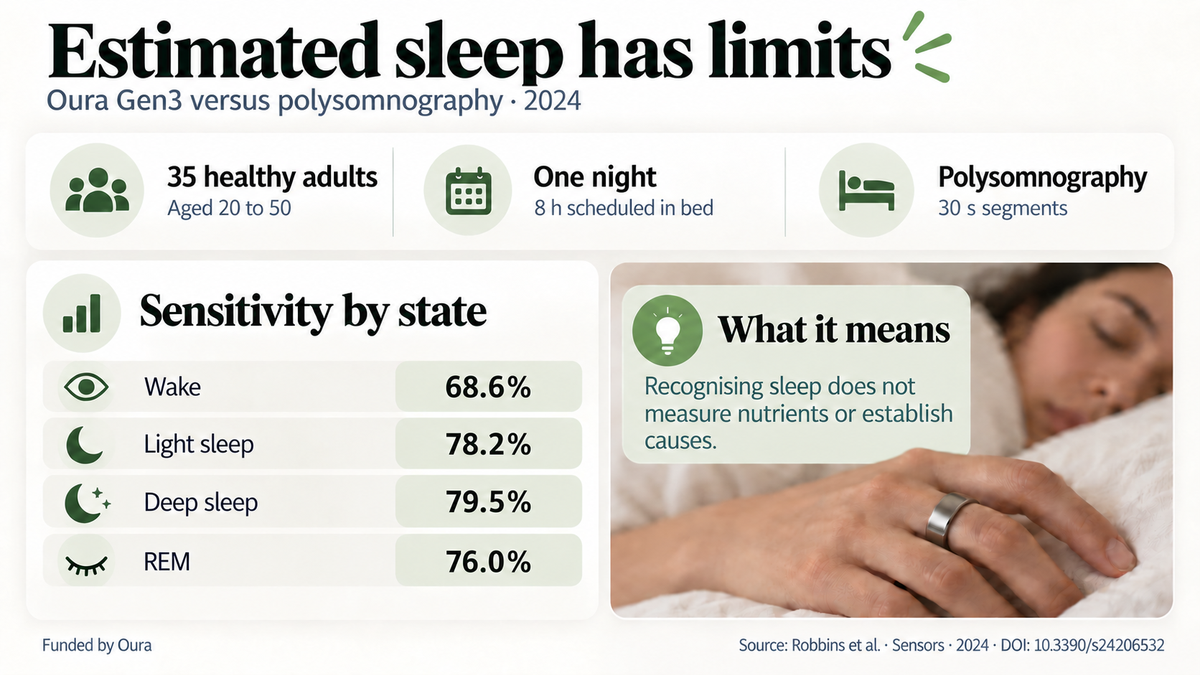
The study was funded by Oura; its first author declares membership on the company's medical advisory board. The small sample size, a single night, and the selection of individuals with healthy sleep limit generalizability. Furthermore, the discussion attributes a figure to deep sleep that the table assigns to light sleep; here we follow table 2, which identifies both states. We do not mix this result with other generations of the device.
The practical lesson is to demand evidence for each feature. Reasonably recognizing sleep does not prove that an app can calculate your protein needs, identify an intolerance, or explain why you had a larger dinner. The study evaluates sleep classification; it does not test Meals or any effect of changing your diet.
An association is for asking, not concluding
Imagine that several late dinners coincide with nights that the ring classifies as worse. There might be a relationship worth observing, but perhaps on those days you also left work later, trained at night, or went to bed afterwards. Dinner shares a context with other variables. Changing it and attributing the entire result to it would be jumping to conclusions further than those logs allow.
Start by defining the question: "What changes on nights when I finish eating dinner later?" Check the recorded schedules and consider comparable days. Add your training, rest, and any circumstances you remember, without turning tracking into an obligation to document everything. A repetition can guide a conversation or a daily adjustment; it does not establish a diagnosis or a universal dietary rule.
Nor should you eliminate a food just because it appears before a poor score. An ingredient, a preparation, and a portion are not equivalent; an isolated night contains too much uncontrolled context. If the log contradicts how you feel, keep both observations. The feeling of rest and the device's estimation provide different information, and neither should disappear just to make the chart look neat.
Coverage matters as much as the chart
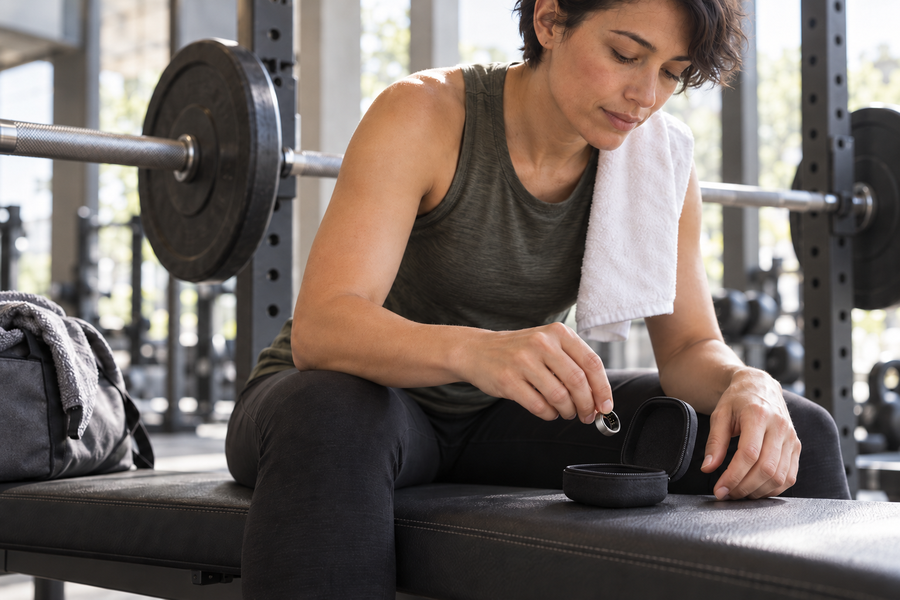
Before a barbell session, a person leaves the ring in an open case; the barbell remains leaning while they prepare for the workout. That example helps us remember that wearing a device does not imply recording every moment of the day. Oura asks for caution with heavy objects to avoid catching or scratching. If you choose to remove it for an activity, check what information is missing afterwards and what your app allows you to add. Do not turn that gap into a complete absence of exercise or an exact amount of calories you must eat.
The same rule applies to the food diary: an unregistered dinner is not equivalent to not having eaten. Before comparing intake and activity, check whether both datasets cover the period. A partial record may describe a meal well and poorly represent the day as a whole. Correcting schedules or adding a forgotten entry usually contributes more than interpreting a difference between incomplete figures.
Glucose, needs, and your own decisions
If you see glucose inside a ring app, identify the sensor that originates the data. Oura documents an integration with the Stelo biosensor and requires specific accounts and requirements; its help documentation limits it to the United States. It is an additional sensor, not a measurement from the ring itself. The FDA warns against watches or rings that promise to measure glucose on their own without piercing the skin; distinguish those products from apps that display data from authorized sensors.
Before adopting the system, consider what question it would solve and what effort it requires to maintain. Review subscriptions, languages, permissions, and data management options. If you only need to remember what your schedules were like, perhaps a simple log already answers that question. Clinical recommendations or persistent symptoms require proper evaluation, not a makeshift explanation based on a score.
Conclusion
A ring can provide context on sleep and activity, while a food log describes what you have recorded. Reviewing them together helps formulate questions when you know what each part measures and what information is missing. The usefulness lies in a prudent, reviewable comparison: recognizing a pattern does not mean measuring nutrients or proving their cause.
Sources and References
- Oura. 2022. How Does Oura Ring Track My Sleep?. Updated September 18, 2026. Accessed: October 7, 2026.
- Oura. 2026. Meals. Updated October 6, 2026. Requirements and language. Accessed: October 7, 2026.
- Robbins, R., et al. 2024. Accuracy of Three Commercial Wearable Devices for Sleep Tracking in Healthy Adults. Sensors, 24(20), 6532. Full text accessed via Europe PMC; Table 2, funding, and conflicts of interest.
- Oura. Product Safety & Use. No identifiable date. Caution with heavy objects. Accessed: October 7, 2026.
- Oura. 2026. Glucose Tracking. Updated October 6, 2026. External sensor and US availability. Accessed: October 7, 2026.
- U.S. Food and Drug Administration. 2024. Do Not Use Smartwatches or Smart Rings to Measure Blood Glucose Levels: FDA Safety Communication. Communication dated February 21, 2024. Accessed: October 7, 2026.