If you've ever downloaded an app to track what you eat, started with enthusiasm, and then abandoned it before a month passed, you're not alone. You're in the majority group. Studies on adherence to nutritional tracking tools show that over 80% of users quit them in the first few weeks — and that says nothing bad about you. It says something very revealing about how those tools were designed.
The problem isn't a lack of willpower. The problem is friction. It's guilt. It's that real life — with its daily specials, its social dinners, and its "I don't know exactly what this contains" — doesn't fit into a food database designed for weighing grams of raw chicken. In this article, we're going to explore why this happens, what science says about adherence to food tracking, and how to build a habit that truly lasts.
The Great Abandonment: Why Almost No One Continues
There was a time when calorie tracking apps were the promised solution for more mindful eating. All you had to do was log everything you ate, the app calculated the nutrients, and you made better decisions. In theory, perfect. In practice, most people quit before the habit consolidates.

This is not a new or minor phenomenon. Research on digital behavior and health has been documenting the same thing for years: the intention to track exists, the initial motivation too, but the habit doesn't consolidate. And when it breaks — a trip, a busy work week, a meal "that's no longer worth logging" — it's rarely resumed.
The interesting thing is that people who quit usually don't do so because they don't care about their diet. They do it because the cost of maintaining the log outweighs the perceived benefit. And when that happens, the brain makes a very rational decision: to stop.
Understanding why this happens is the first step to changing it.
The Five Real Reasons Why You Stop Tracking
1. Friction is too high
Searching for "cooked white rice" in a database, choosing from 47 different versions, estimating whether it was 180 or 200 grams, and repeating this for every component of the dish — all before taking the first bite. It's exhausting. And as soon as the process becomes tedious, the brain starts looking for excuses to skip it.
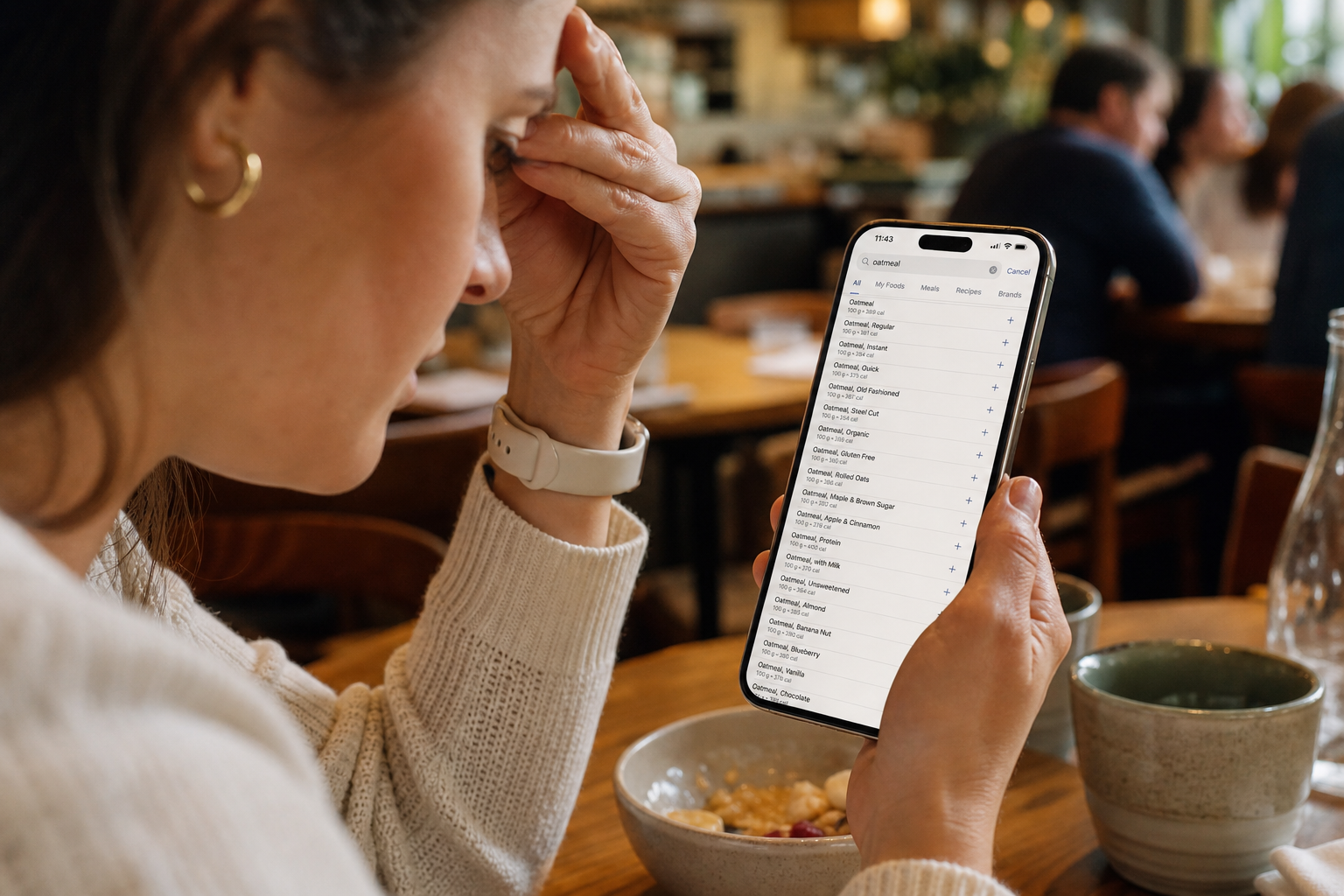
Friction is the silent enemy of any habit. It doesn't need to be unbearable — it just needs to be slightly more uncomfortable than the alternative of doing nothing. In behavioral design, this is known as "activation cost": the greater the initial effort, the lower the probability that the behavior will be repeated the next day, and the day after, and the day after that.
Traditional calorie-counting apps have a high activation cost by design. They were built with highly committed users in mind for detailed logging — athletes, people with specific clinical goals — not for someone who simply wants to know if they are eating reasonably well.
2. Guilt becomes unbearable
The second major habit killer is guilt. When you eat something you "shouldn't have" — a pizza, some fries, an unplanned dessert — logging it becomes an act of self-accusation. And no one wants to do that voluntarily.
Some people develop a very specific pattern: they log well when they eat well, and stop logging when they eat worse. The result is a biased history that doesn't reflect reality and an increasingly anxious relationship with food. When logging becomes a moral judgment, it stops being a tool and becomes a problem. The app stops being a compass and turns into a courtroom.
3. The data tells you nothing useful
If you've been logging everything you eat for weeks but the data tells you nothing concrete — if you don't see patterns, if you don't understand what's working and what isn't — motivation evaporates. Logging without clear feedback is work without reward.
Apps that only show a calorie count at the end of the day have exactly this problem. The data exists, but it doesn't help in making decisions. Are you eating too much ultra-processed food? Do your Fridays unbalance the whole week? Do you eat a good breakfast but lose control in the afternoon? Without that layer of interpretation, the numbers are just noise — and the brain quickly learns to ignore noise.
4. The All-or-Nothing Syndrome
"I've already broken the streak, why bother continuing." This phrase — or some variant of it — is responsible for thousands of abandonments every day. The perfectionist mindset turns any single failure into a total defeat. If you didn't log anything on Wednesday, you feel there's no point in continuing on Thursday.
This pattern has a name in psychology: dichotomous thinking or black-and-white thinking. Applied to eating habits, it is especially destructive because eating is inherently imperfect. Nobody eats the same way every day. Nobody should have to.
5. Real Life Doesn't Fit in a Database
Dinners out. The daily special whose ingredients you don't know exactly. Sunday tapas. The omelet your mother made. The real world of eating is messy, social, and contextual — and it's very difficult to capture in text fields and grams.
When logging becomes impossible because you can't find what you've eaten in any database, the natural reaction is to quit. And when that happens two or three times in a row for the same reason, the abandonment stops being temporary and becomes permanent.
What Science Says About Logging Adherence
The scientific evidence on food logging is clear on one thing: it works when done, but adherence is the Achilles' heel. A meta-analysis published in the Journal of the Academy of Nutrition and Dietetics found that self-monitoring food intake is associated with greater nutritional awareness and better food choices — but the dropout rate in studies is consistently high, especially after the fourth week.
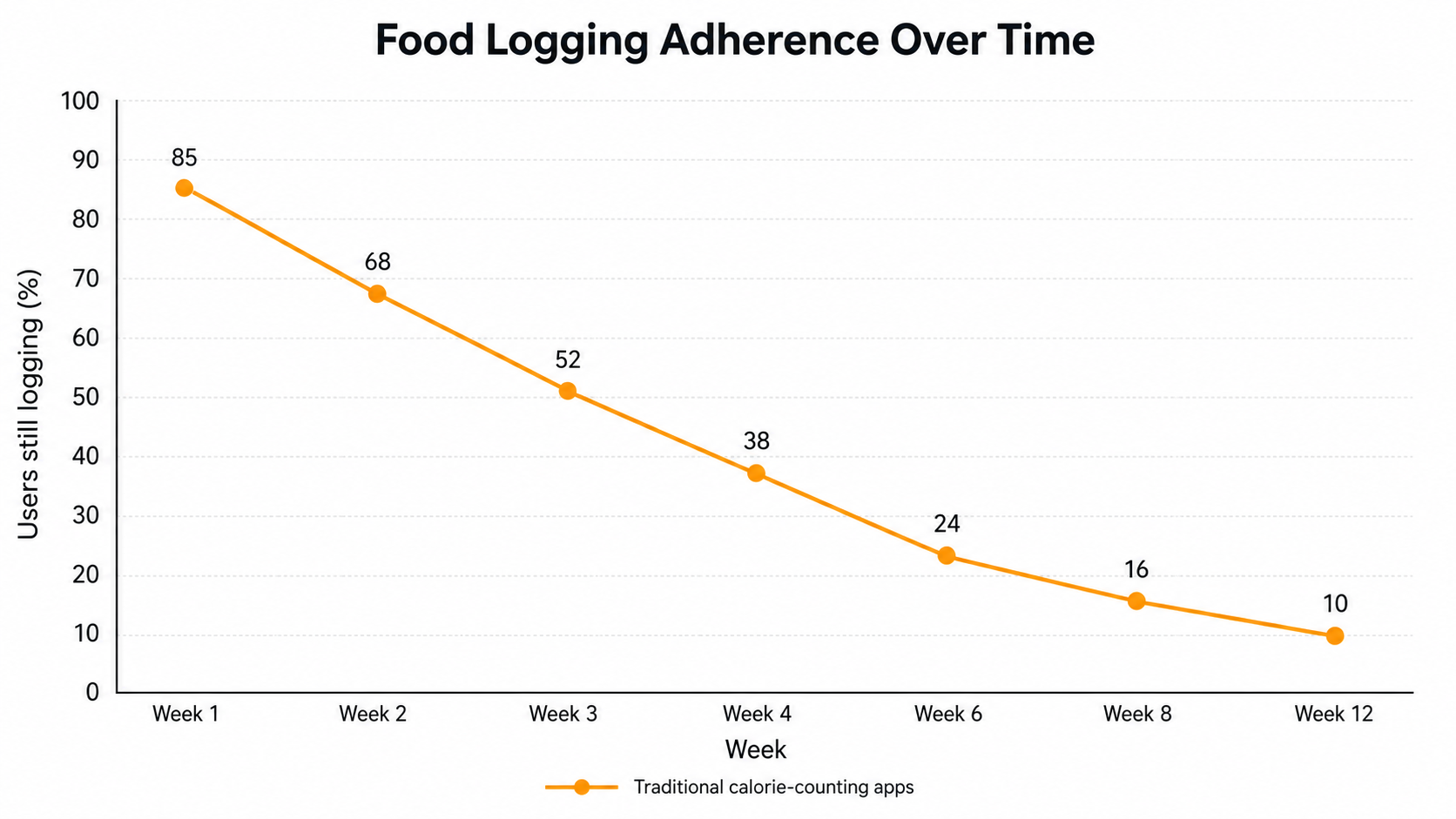
What researchers have found is that the factors that best predict adherence are not motivation or discipline, but the simplicity of the method and the perceived usefulness of the data. In other words: people continue when logging is easy and when the data tells them something they can apply the next day.
Habits are not formed thanks to motivation, but thanks to design. When we make a behavior small and easy enough to execute, motivation ceases to be the determining factor.
This principle is directly applicable to food logging. The right question is not how to motivate people to log more, but how to design logging so that it is so simple it doesn't require extraordinary motivation to do it. A habit that depends on daily willpower is a fragile habit. A habit integrated into the natural routine — like taking out your phone and snapping a photo — is a robust habit.
How to fix it: principles that work
After understanding why it's abandoned, the solution isn't "having more willpower." It's changing the system. These are the principles that research and practice indicate are most effective for building a logging habit that lasts.
Reduce the activation cost to the absolute minimum. The ideal log is one you can make in the moment, without interrupting your meal, without looking for anything. The faster and more natural the process, the more likely you are to repeat it tomorrow, and the day after, and next week.

Separate logging from judgment. The goal of logging isn't to behave well — it's to know the reality. A day with pizza honestly logged is infinitely more valuable than a perfect week on paper that doesn't reflect what you actually eat. Treat logging like a temperature sensor, not a behavior exam.
Prioritize consistency over accuracy. You don't need to know if you ate 180 or 210 grams of pasta. You need to know that you ate pasta, approximately how much, and what else was on the plate. An honest estimation repeated over time gives you a much more useful picture than an exact measurement you abandon after two weeks. A photo of a dish captures that information naturally, without you having to think about grams.
Seek meaningful feedback. Data only motivates when you understand it and when it tells you something actionable. A score per dish, a weekly note, a clear pattern of evolution — these are the signals that keep the habit alive because they turn the effort of logging into useful information for making better decisions tomorrow.
Technology as an ally, not a jailer
For years, nutrition apps were designed with the most demanding use case in mind: the user who weighs food, logs every ingredient, and wants exact data. That user exists, but they are a minority. Most people who want to track their eating habits don't need that precision — they need ease, consistency, and useful feedback.
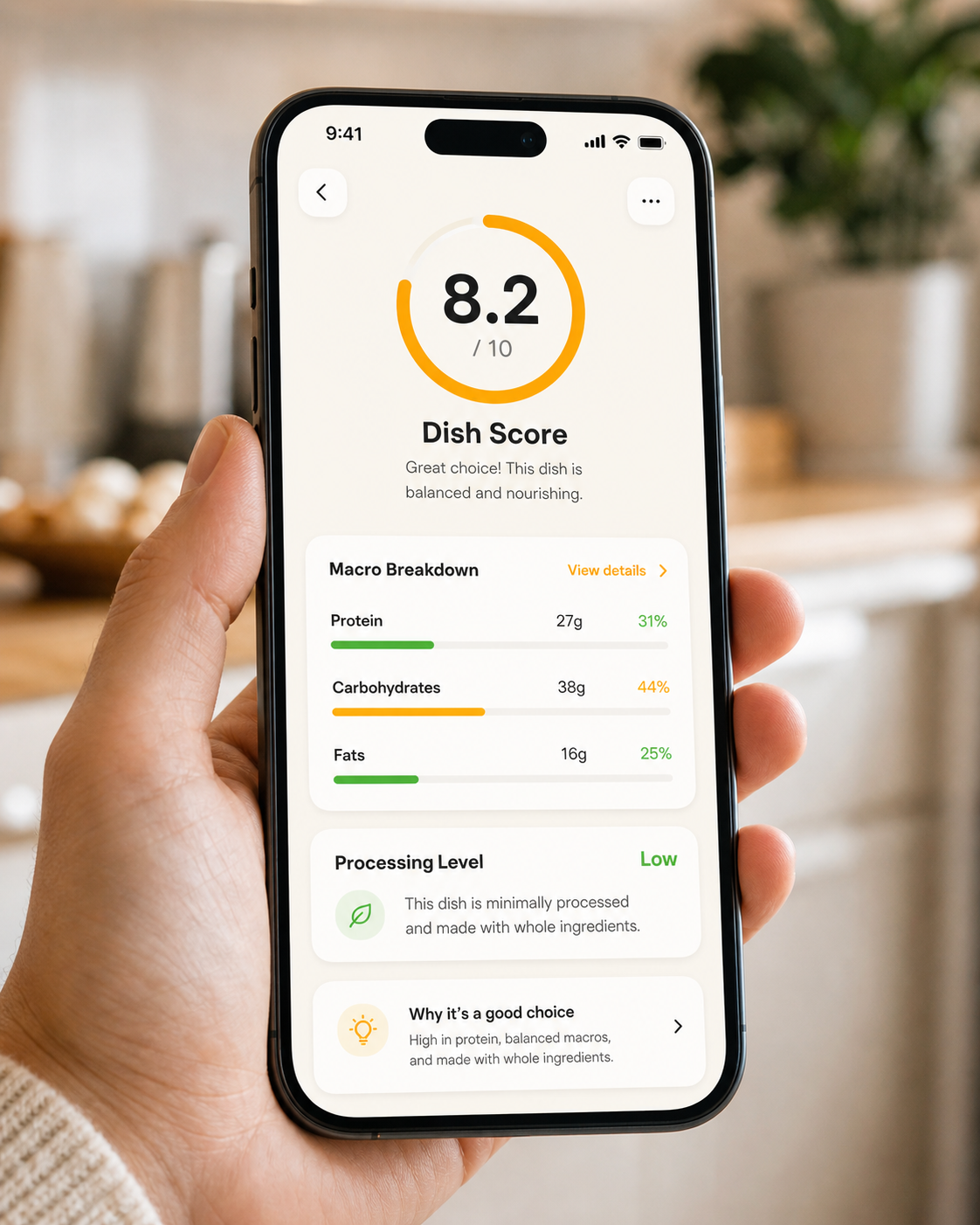
Photography as a logging method is a paradigm shift because it eliminates almost all friction. There's no need to search for foods in databases, no need to weigh portions, no need to choose between similar versions of the same food. The process is so close to the natural way of interacting with food — we look at it, photograph it, eat it — that the activation cost approaches zero. And when the activation cost is almost zero, the habit has a real chance of surviving.
Tools like Calegg have gone beyond simple calorie counting: in addition to macros, they analyze the industrial processing level of the dish and the percentage of plant-based foods — vegetables, fruits, legumes, and nuts —, offering a much more complete and honest nutritional picture of what you are actually eating. And they do this by returning a score per dish and weekly statistics that convert raw data into actionable information: you can see at a glance if you are on the right track, which days of the week you lose pace, or if your dietary variety has improved compared to the previous week.
The most important thing in nutrition is not perfect tracking of every nutrient, but understanding overall dietary patterns over time. It is these patterns that determine long-term health.
That's exactly what a good logging system does: it doesn't replace your judgment, it trains it. It helps you see patterns that would otherwise be invisible — because when you eat every day without logging anything, it's impossible to know if Fridays systematically throw you off balance, or if your breakfast is much better than you thought, or if you really eat as few vegetables as you suspect. Logging, when well-designed, turns intuition into knowledge.
Conclusion
Stopping logging what you eat is not a failure of willpower — it's a completely logical response to tools that make the process too difficult, too guilt-inducing, or too unhelpful. The problem was never that you didn't want to track your eating. The problem was how that tracking was designed.
The good news is that the principles for building a lasting logging habit are clear: reduce friction to a minimum, separate data from judgment, prioritize consistency over perfection, and seek feedback that truly tells you something useful about your real behavior. With these foundations, logging stops being a burden and becomes what it always should have been: a compass. Not to control you, but to guide you.
And if you've been trying to get back into the habit for weeks — or years — without success, maybe it's not that you're a bad patient. Maybe you deserve a better-designed tool.