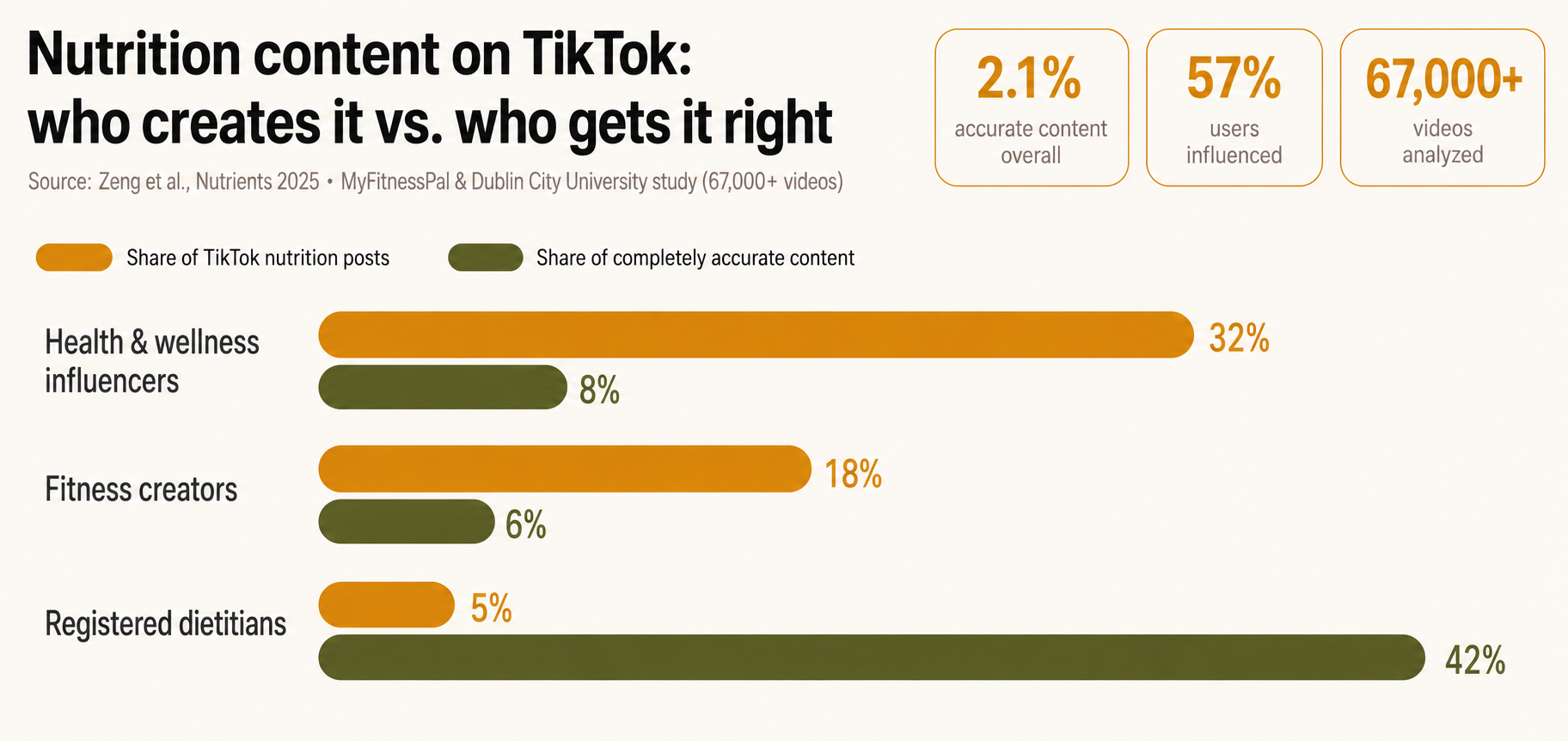
Imagine you open TikTok and in less than ten seconds someone tells you to stop eating fruit because it has "too much sugar," that gluten destroys your gut even if you don't have any intolerance, or that fasting sixteen hours a day is the key to resetting your metabolism. These are videos with millions of views, catchy music, and a beautiful, self-assured person pointing to data on screen. The problem is that almost everything you hear is false. A study conducted by MyFitnessPal in conjunction with Dublin City University analyzed over 67,000 nutrition videos on TikTok and reached a devastating conclusion: only 2.1% of the content was accurate according to public health guidelines. The rest, 97.9%, was inaccurate, misleading, or directly impossible to verify.
The Algorithm Doesn't Understand Nutrition
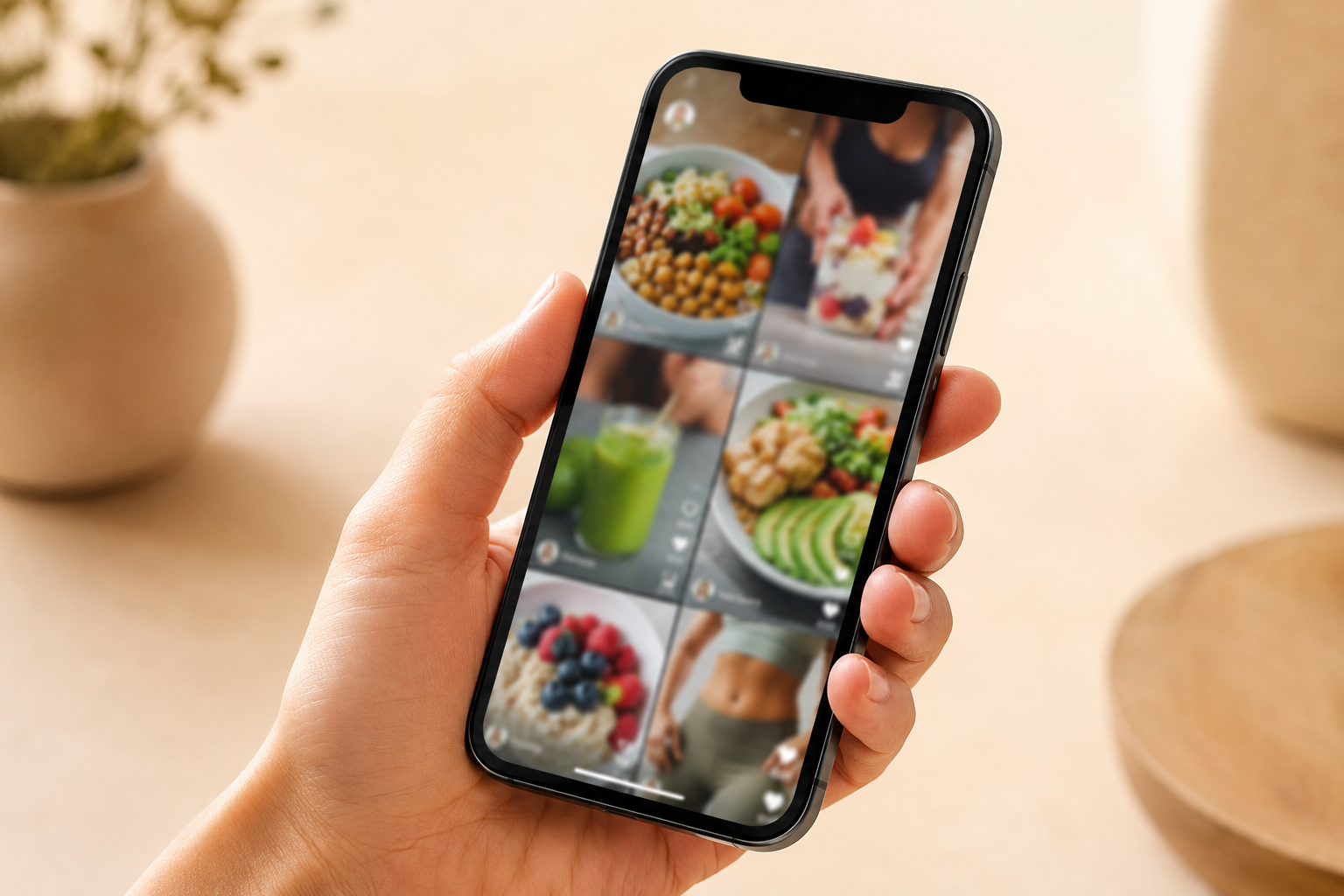
TikTok is not designed to teach you how to eat well. It's designed to keep you on the app for as long as possible. And the content that best achieves that goal is not the most rigorous, but the most surprising, controversial, or emotionally intense. Nutritional science is nuanced, slow, and often boring. A thirty-second video promising "the trick doctors don't want you to know" is the exact opposite.
Researchers from the University of Sydney who published the study #WhatIEatinaDay in the journal Nutrients in 2025 found something even more concerning: completely inaccurate posts received significantly more likes, comments, and saves than accurate ones. The algorithm, in essence, rewards misinformation because it generates more reaction. It's not a system failure. It's exactly how it's designed.
The Numbers That Should Worry You
The gap between who talks about nutrition on TikTok and who knows about nutrition is enormous. The most common profile of a nutritional content creator on the platform is the health and wellness influencer, accounting for 32% of posts, followed by fitness creators at 18%. Registered dietitians, however, only appear in 5% of the content. And yet, they are the only group that produces mostly reliable information: 42% of their videos are classified as completely accurate compared to marginal percentages in the other groups.
The most common topic in TikTok nutrition videos is weight loss, which accounts for 34% of all content. And it is precisely in this category where misinformation is most severe: 28% of these videos contain completely inaccurate information. Drastic elimination diets, extreme fasting, miraculous supplements — all packaged in short videos with millions of views. 31% of users who tried any of these trends reported experiencing adverse effects.
How to Spot a Nutrition Hoax in 5 Seconds
You don't need to be a nutritionist to detect the most common red flags. The first is urgency: any video that promises quick, dramatic results or "in X days" is selling fantasy, not science. The second is the total elimination of a food group — carbohydrates, sugar, dairy — without nuances or context. Real nutrition rarely works in absolutes.
The third sign is the absence of visible credentials. In many countries, anyone can call themselves a "nutritionist," but the title of registered dietitian-nutritionist is regulated and requires specific university training. Look in the creator's bio for mention of their studies or professional registration number. If nothing appears, be suspicious.
The fourth sign is conspiratorial language: "what the food industry hides," "the secret doctors don't want you to know." This type of framing is not science communication; it's entertainment disguised as information. And the fifth, perhaps the most difficult to detect, is an undeclared conflict of interest: the same creator who advises you on supplements also sells their own. The University of Sydney study found that 77% of the analyzed posts did not disclose any commercial affiliation or sponsorship.
Conclusion
TikTok isn't going anywhere, and it's not going to stop producing viral nutrition advice. What you can change is how you consume it. Look for creators with verifiable credentials, cross-reference any recommendation that seems extreme with official sources or your doctor, and remember that the most eye-catching content is rarely the most useful. In nutrition, as in almost everything, what works is usually less spectacular than what goes viral. Eating well doesn't fit into thirty seconds — and that's precisely what the algorithm will never tell you.